
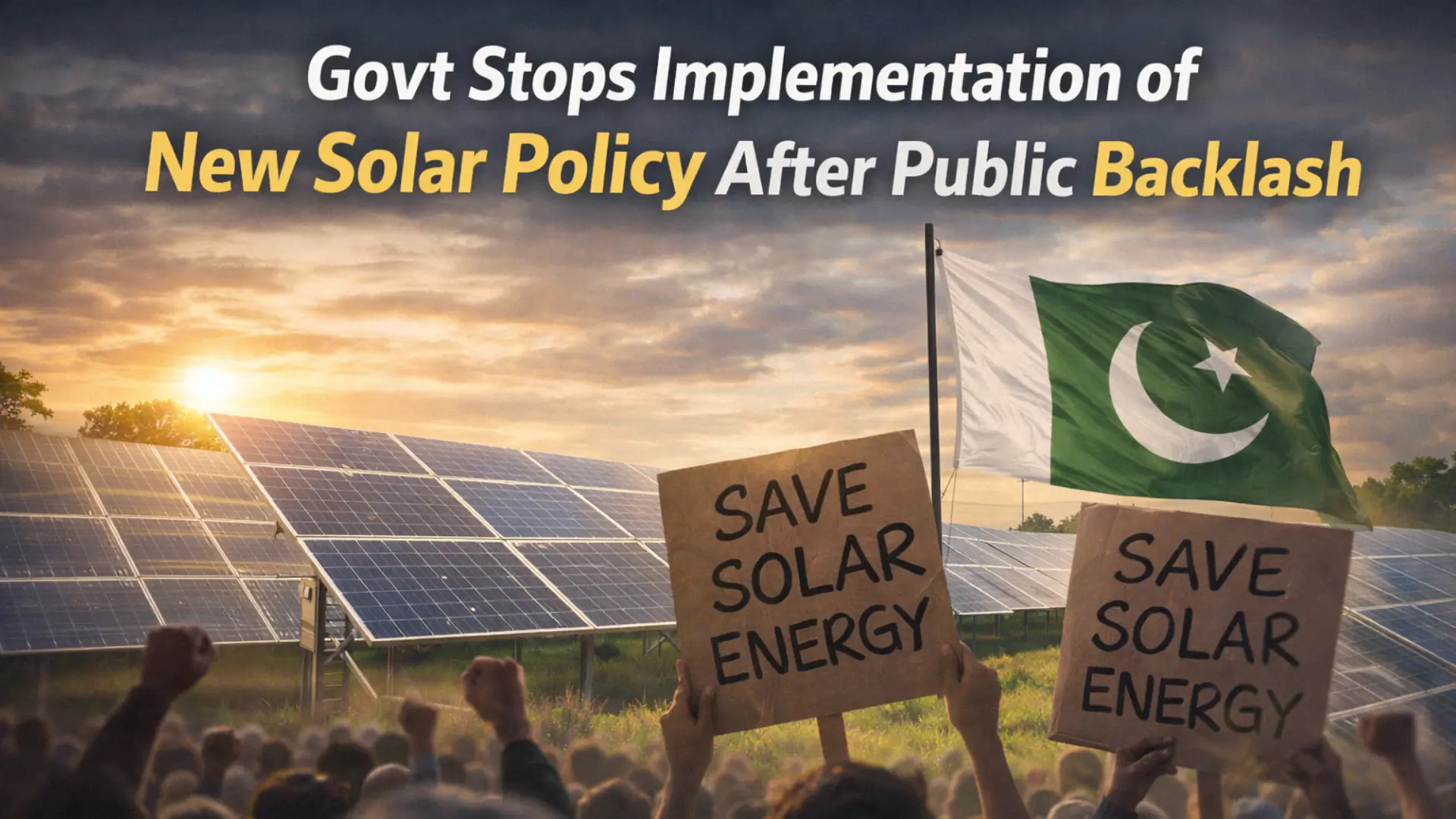

Govt Stops Implementation of New Solar Policy After Public Backlash. The federal government has officially halted the implementation of its proposed solar policy, which aimed to shift consumers from net metering to net billing. The decision comes after mounting political criticism and public backlash over concerns that the move would negatively impact solar consumers across the country.
The government has also announced that it will file an appeal against the regulator’s decision, signaling that the matter is far from settled. The issue was discussed in detail during a session of the National Assembly, where Federal Minister for Power Division Awais Leghari defended the government’s broader power sector reforms.
Net Metering vs. Net Billing Controversy
The controversy revolves around the government’s plan to transition solar consumers from net metering to net billing. Under the current net metering system, consumers with solar panels can sell excess electricity back to the national grid at a predetermined rate.
However, the proposed net billing model would change how consumers are compensated for surplus electricity. Critics argued that this shift could reduce financial benefits for solar users and discourage investment in renewable energy.
Due to strong opposition from political parties, solar consumers, and industry stakeholders, the government has decided to temporarily stop the implementation of the new policy.

Government’s Defense of Power Sector Reforms
Speaking in the National Assembly, Federal Minister Awais Leghari stated that criticism of the net metering issue should be viewed within the broader framework of ongoing power sector reforms.
He highlighted that the government has reduced circular debt by Rs. 780 billion and renegotiated agreements with Independent Power Producers (IPPs), resulting in a financial relief of Rs. 3,400 billion.
The minister further revealed that tariffs of several IPPs have been reduced. He claimed that even a project linked to a relative of the prime minister saw cuts worth Rs. 100 billion, emphasizing transparency in reforms.
Additionally, electricity tariffs for industrial consumers have been reduced in an effort to boost economic activity and support businesses.

Current Solar Power Capacity in Pakistan
Providing updated figures, the minister said that total solar power capacity in Pakistan currently ranges between 20,000 and 22,000 megawatts.
Out of this:
- Around 6,000 megawatts fall under net metering.
- Approximately 7,000 megawatts belong to the industrial and commercial segment.
- Nearly 700,000 consumers are currently using net metering.
He also mentioned that by December 2025, capacity under net metering had reached 7,000 megawatts, while off-grid solar capacity stands at 12.62 megawatts.
Is Net Metering Fair for All Consumers?
The power minister questioned whether the current net metering policy is equitable for all electricity consumers.

He pointed out that the government purchases electricity at Rs. 27 per unit under net metering, while it receives electricity from other sources at approximately Rs. 8 per unit. He argued that around 35 million consumers are not part of net metering, raising concerns about fairness.
According to official data, only 8 to 10 percent of consumers nationwide benefit from net metering. In Islamabad’s F and G sectors, most solar systems are on net metering, while suburban areas such as Burma Town have significantly fewer systems under the scheme.
Load Shedding Situation Across the Country
During the question hour session, the Power Division revealed alarming statistics about load shedding.
Out of 12,665 feeders nationwide, about 2,223 feeders are experiencing load shedding exceeding 10 hours per day.

The worst-affected areas include:
- Quetta Electric Supply Company (QESCO): 604 out of 814 feeders facing over 10 hours of load shedding.
- Sukkur Electric Power Company (SEPCO): 407 out of 707 feeders affected.
- Tribal Areas Electric Supply Company (TESCO): 174 out of 357 feeders impacted.
- Peshawar Electric Supply Company (PESCO): 642 out of 1,376 feeders experiencing extended outages.
In contrast, Lahore Electric Supply Company (LESCO), Islamabad Electric Supply Company (IESCO), Gujranwala Electric Power Company (GEPCO), and Faisalabad Electric Supply Company (FESCO) reportedly have no feeders facing more than 10 hours of load shedding.
Transmission Losses and Financial Challenges
The minister disclosed that total transmission losses exceeded Rs. 600 billion over two years.
- In FY24, losses stood at Rs. 322 billion.
- In FY25, losses were recorded at Rs. 284 billion.
Among distribution companies, PESCO recorded the highest losses at Rs. 96 billion, followed by:

- Rs. 51 billion in Quetta
- Rs. 46 billion in Lahore
- Rs. 37 billion in Sukkur
- Rs. 22 billion in Hyderabad
Between July and December 2025, electricity consumption reached 8.78 billion units, while the total number of electricity consumers across 11 distribution companies stands at 39.22 million.
The number of protected consumers has increased significantly to 21.55 million, compared to 9.5 million in October 2021.
Circular Debt and Ongoing IPP Negotiations
According to the power minister, electricity consumers are currently paying Rs. 310 billion annually to service circular debt.
He stated that multiple agreements with IPPs have been revised, and the financial relief obtained has been passed on to consumers. Negotiations with additional IPPs are still ongoing.
Furthermore, projects totaling 7,967 megawatts of high-cost electricity have been cancelled to reduce financial burden on the power sector.
Conclusion
The federal government’s decision to stop the implementation of the new solar policy reflects the intense public and political pressure surrounding the net metering debate. While the government argues that reforms are necessary to ensure fairness and reduce financial strain, critics believe renewable energy incentives must be protected.