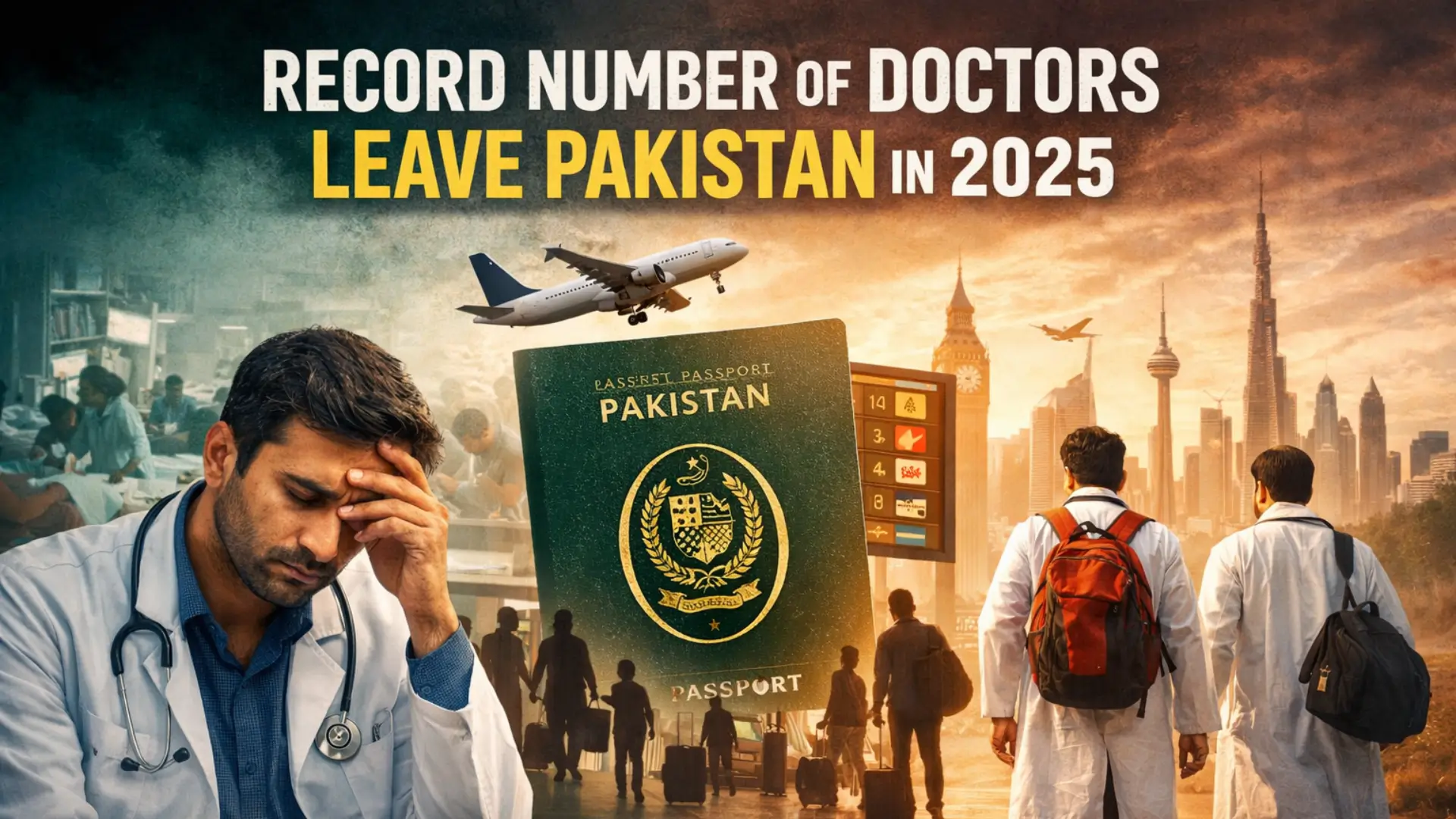

Doctors Leave Pakistan in 2025. The year 2025 has become a turning point for Pakistan’s healthcare system. A record number of doctors left the country, raising serious concerns about the future of medical care. This happened despite the fact that Pakistan produces thousands of new doctors every year. On paper, the numbers look strong. On the ground, the situation is worrying.
According to an analysis by Gallup Pakistan, based on data from the Bureau of Emigration, around 3,800 to 4,000 doctors emigrated from Pakistan in 2025. This is the highest number ever recorded in a single year. In earlier decades, the number of doctors leaving the country usually stayed in the hundreds. The sharp rise shows that something has clearly changed.
Growing Problem, Not a Sudden One
Doctor migration from Pakistan did not start overnight. Researchers explain that this trend began to grow after 2010. Every year, more doctors decided to move abroad. By 2025, this slow rise turned into a historic peak.
Experts describe this shift as a structural change. This means the problem is deep and long-term. Pakistan may now be training doctors mainly for foreign countries instead of keeping them to serve local patients. This is a serious issue for a country with a large and fast-growing population.
Why Are Doctors Leaving Pakistan?
There are many reasons why doctors choose to leave. One major reason is low pay. Many young doctors work long hours in public hospitals but earn salaries that barely meet basic needs. In some cases, they also face delays in payments.
Working conditions are another big issue. Government hospitals are often overcrowded. Doctors have to treat too many patients with limited equipment. This leads to stress, burnout, and frustration.

Career growth is also slow. Promotions can take years. Training opportunities are limited. In contrast, countries in the Gulf, Europe, and the UK offer better salaries, modern hospitals, and clear career paths. For many doctors, the choice becomes simple.
Numbers That Can Be Misleading
Pakistan produces around 22,000 new doctors every year. Official records show nearly 370,000 registered doctors in the country. At first glance, these numbers suggest that Pakistan has enough medical professionals.
However, health officials warn that these figures do not show the full picture. Many registered doctors are not practicing medicine at all. Some are unemployed. Some work in non-clinical jobs. Others have already moved abroad but remain registered in Pakistan.
Because of this, the real number of doctors available to treat patients is much lower than it appears on paper.
Population Pressure and Doctor Shortage
Pakistan’s population is close to 250 million. According to the World Health Organisation, the minimum standard is one doctor for every 1,000 people. This means Pakistan needs at least 250,000 actively practicing doctors.

While the country seems to meet this requirement on paper, experts say the reality is different. Many rural areas have very few doctors. Small towns struggle to keep specialists. Big city hospitals are overcrowded and overworked. As more doctors leave the country, this gap continues to grow.
Impact on the Healthcare System
The constant outflow of doctors puts heavy pressure on the healthcare system. Fewer doctors mean longer waiting times for patients. Emergency services suffer the most. In some hospitals, one doctor may be responsible for dozens of patients at the same time.
This situation affects the quality of care. Doctors are exhausted. Patients do not get enough attention. Preventive care, such as early diagnosis and regular checkups, becomes harder to provide.
There is also a financial loss. The government spends a large amount of money on medical education. When trained doctors leave, that investment benefits other countries instead of Pakistan. This is a classic example of brain drain.
Private Medical Colleges and High Fees
At the same time, medical education in Pakistan has become very expensive. Private medical colleges charge very high fees. For many middle-class families, paying for an MBBS degree is almost impossible.

High fees also increase pressure on students. Many graduates feel they must work abroad to recover the money spent on their education. This further fuels doctor migration.
To address this issue, the government has set a maximum annual fee limit for private medical colleges. The goal is to make medical education more affordable and fair.
This decision has been welcomed by many families and students. However, experts say this step alone is not enough.
More Than Just Fee Control
Controlling fees is important, but it does not solve the full problem. The quality of training must also be improved. Medical students need better teaching hospitals, proper internships, and modern equipment.
After graduation, doctors need clear paths for specialization and professional growth. If these opportunities are not available in Pakistan, doctors will continue to look abroad.

The healthcare system also needs strong management. Transparent hiring, fair promotions, and safe working environments can make a big difference.
Can Pakistan Retain Its Doctors?
Keeping doctors in the country will not be easy, but it is possible. First, salaries must match the cost of living. Doctors should feel financially secure.
Second, working conditions must improve. Hospitals need better facilities, more staff, and updated technology. This will reduce stress and improve patient care.
Third, rural service should be made attractive. Providing housing, extra allowances, and security can encourage doctors to work in smaller towns and villages.
Respect and recognition also matter. Doctors want to feel valued by society and the system they serve.

Warning for the Future
Gallup researchers warn that the rising number of doctors leaving Pakistan is not just a short-term issue. It is a sign of a deeper problem. If the trend continues, Pakistan may face serious healthcare shortages in the future.
Training more doctors without fixing the system will not help. Medical education, workforce planning, and national health policy must work together. Otherwise, Pakistan will continue to lose its best medical talent.
Conclusion
In 2025, Pakistan saw a record number of doctors leave the country, putting the healthcare system under serious strain. Producing more doctors is not enough. Better pay, working conditions, and career growth are essential to retain medical professionals and protect the nation’s healthcare future.