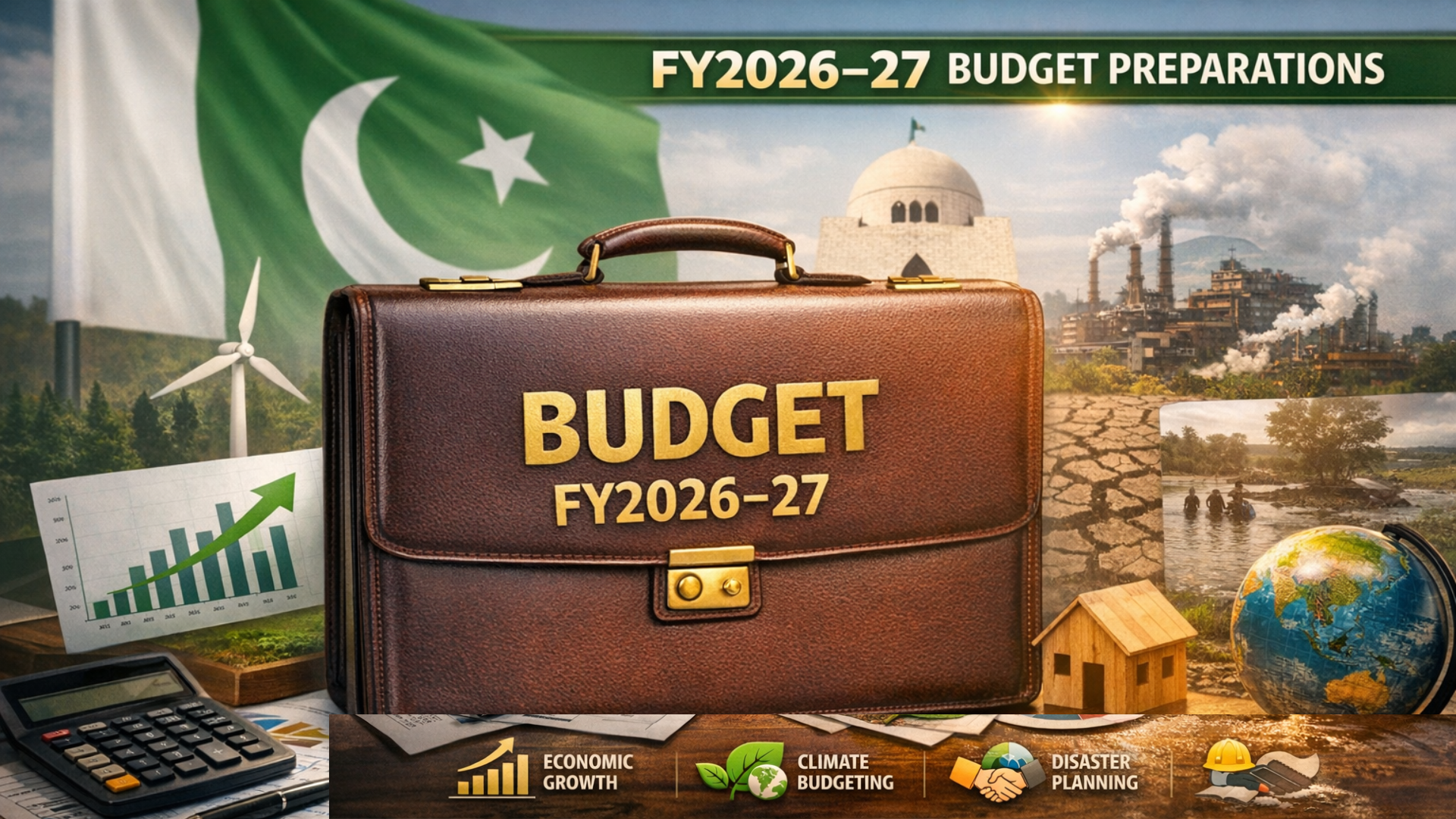

Govt Starts Budget Process for FY2026–27. The government has officially started work on the federal budget for the fiscal year 2026–27. The Finance Division issued the Budget Call Circular, also known as the BCC. This document gives clear instructions to all ministries and departments. It explains economic priorities, sets a complete budget schedule, and introduces new rules for climate and disaster-related spending. For the next fiscal year, the government expects economic growth to reach 5.1 percent, while inflation is projected at 6.5 percent.
Economic Outlook and Growth Targets
Along with the BCC, the government released a provisional macroeconomic framework. This framework shows how the economy is expected to perform over the next two years. For FY2025–26, GDP growth is projected at 4.0 percent. In FY2026–27, growth is expected to rise further to 5.1 percent. Inflation is forecast to ease to 6.1 percent in FY2025–26 and then increase slightly to 6.5 percent in FY2026–27. These projections are based on stable global commodity prices and ongoing structural reforms.
New Budget Instructions for Ministries
The new budget instructions have been shared with all ministries and Principal Accounting Officers. They are now required to clearly identify and tag revenues and expenditures that have climate or environmental relevance. This applies when submitting actual spending data for FY2024–25, revised estimates for FY2025–26, and budget estimates for FY2026–27. The purpose is to improve transparency and make climate-related spending easier to track.

Introduction of Climate and Green Budgeting
For the first time, the Budget Call Circular includes detailed guidance on climate and green budgeting. This covers climate-linked tax and non-tax revenues, subsidies, and disaster-related expenditures. The government aims to align fiscal policy with climate resilience and sustainable development. Officials believe this approach will support economic recovery while addressing rising climate risks in the country.
Climate-Based Revenue Classification
Federal revenue mainly comes from tax and non-tax sources. Tax revenue is collected by the Federal Board of Revenue, while non-tax revenue is managed by the Finance Division. Under the new system, non-tax revenues will be assessed based on the environmental impact of related activities. Charges on environmentally harmful activities, such as fossil fuel use, plastic production, and hazardous waste, will be counted as climate-related revenues.

Four Categories of Green Revenues
To follow international reporting standards, the Finance Division has introduced four main categories for green revenue classification. These categories are Energy, Transport, Pollution, and Natural Resources. They include petroleum levies, emissions from energy use, vehicle and road usage charges, waste management fees, noise pollution penalties, and charges on the extraction and use of natural resources like water and forests.
Climate Tagging of Subsidies
The government has also extended climate tagging to subsidies, which form a significant part of the federal budget. While climate tagging was already applied to government operations and development projects, it will now include subsidies starting from FY2025–26. A new reporting format, Form III-C, has been introduced to support this process.

Subsidy Classification and Impact Assessment
Under the new system, ministries must list each subsidy by department, sector, and budget amount. They must also classify whether the subsidy supports climate adaptation or climate mitigation. Adaptation includes measures like agricultural risk management, crop insurance, and climate-resilient infrastructure. Mitigation includes clean energy projects, renewable power, energy efficiency programs, public transport, and electric vehicles.
Subsidies will also be tagged based on their environmental impact. These tags include directly favourable, indirectly favourable, neutral, mixed, or potentially unfavourable. This will help the government review whether subsidies support climate goals or increase environmental pressure.

Disaster Budgeting and Climate Risks
Disaster budgeting remains a major focus due to Pakistan’s vulnerability to climate-related disasters. All disaster-related spending will continue to be tagged across the federal budget. This includes pre-disaster spending on prevention and preparedness, as well as post-disaster spending on emergency response, recovery, and reconstruction. Each category will carry a specific code to improve monitoring and accountability.
Budget Timeline for FY2026–27
The Finance Division has announced a detailed timeline for the budget process. The provisional macroeconomic framework will be prepared in the current month. A mid-year review report will be presented to the National Assembly in February 2026. All ministries must submit budget forms, revised estimates, and development project details by February 20, 2026.

Meetings of the Budget Review Committee will be held from March 30 to April 12, 2026. Exchange rate assumptions will be announced on April 15, 2026. The Budget Strategy Paper will be approved by April 20, 2026. Budget ceilings will be issued between April 21 and April 25, 2026. The Annual Plan Coordination Committee will meet in the first week of May, followed by the National Economic Council meeting in the second week of May.
All budget documents will be finalized by the end of May 2026, and quarterly budget estimates must be submitted by June 30, 2026.
Conclusion
With the issuance of the Budget Call Circular, the government has formally launched the FY2026–27 budget process. The inclusion of climate and green budgeting, subsidy tagging, and disaster planning shows a shift toward more responsible and transparent fiscal management. This approach aims to support economic growth while addressing environmental and climate challenges in the coming years.